Counterfeit drugs:
'People are dying every day'
Technology of
Business

Imagine seeing your child suffering from malaria, one of the
biggest killers of children across the world. Symptoms include high fever,
sweating, vomiting and convulsions.
But it's OK, you think, because you bought medicine to combat
the disease from a local drugs market.
Now imagine what it must be like to see your child die
nonetheless because the drugs you bought were fake.
That is the brutal reality of the multi-billion dollar a year
global trade in counterfeit drugs.
More than 120,000 people a year die in Africa as a result of
fake anti-malarial drugs alone, says the World Health Organization, either
because the drugs were substandard or simply contained no active ingredients at
all.
Even medicines that are substandard - containing an insufficient
dosage of active ingredients, say - can be deadly, leading to drug resistance,
a particular issue for infectious diseases like malaria and tuberculosis.
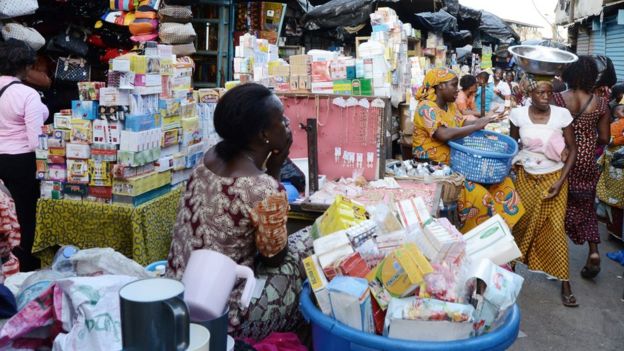
By some estimates, about a third of all anti-malarial drugs in
sub-Saharan Africa are fake. And these fakes can find their way into
pharmacies, clinics and street vendor stalls, or be sold online via thousands
of unregulated websites.
But a handful of start-ups have been trying to tackle the issue
using technology.
'Simple and cheap'
Not-for-profit organisation, Sproxil, offers a beguilingly
simply solution.
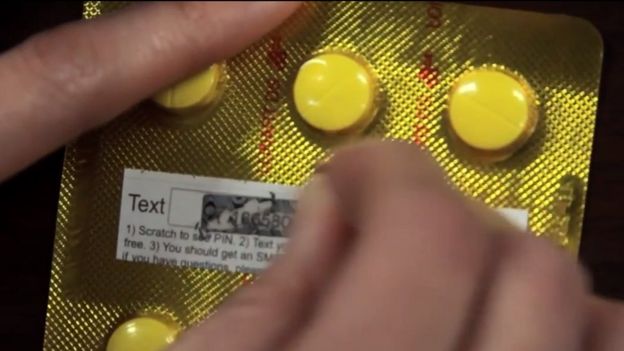
Participating drugs companies apply for scratch-panel stickers
that can be attached to their packets of drugs. Customers scratch off the panel
to reveal a code which they text to Sproxil. The company checks the code
against its database of genuine drugs and texts back a confirmation of
authenticity.
Buyers can also scan the barcode or simply ring a call centre
staffed 24 hours a day, seven days a week to verify that the drugs are genuine.
And Sproxil has introduced incentives for consumers to use the service, such as
mobile phone air time rewards.
More than 70 drugs companies have signed up to the service,
including multinationals such as GlaxoSmitKline and Novartis, says Sproxil
spokesman Tolulope Gbamolayun, and about 28 million verifications have taken
place globally since the scheme was launched in 2009.
"It's a security measure that is simple and cheap,"
says Mr Gbamolayun.
In Africa, the scheme operates in Kenya, Ghana, Nigeria, South
Africa, Tanzania, and most recently, Mali.
"But we're trying to spread our tentacles across all the
countries of Africa," he says.
Catching the fraudsters
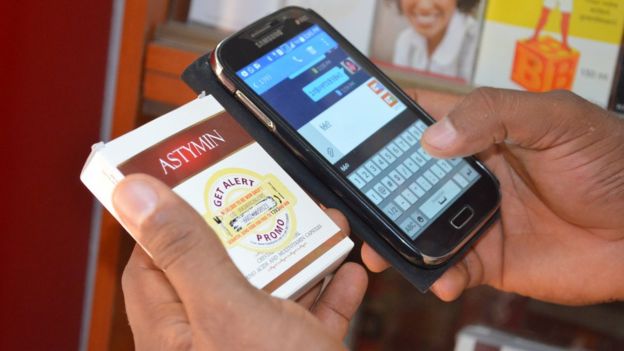
Social entrepreneur Bright Simons set up a similar
"verify-by-mobile" system called mPedigree Network nearly 10 years
ago.
Printed barcodes and scratch-off stickers, developed in
partnership with US tech giant Hewlett-Packard, help consumers check
authenticity against a central database.
"But you need to be able to track the product at each stage
of its journey from the factory to the consumer," Mr Simons tells the BBC.
"The consumer app was easy to develop, but the back-end was much more
difficult."
He says mPedigree's Goldkeys product helps manufacturers and
regulators "monitor the entire supply chain. In Nigeria, our technology
has helped regulators pinpoint where fraud is happening and catch the
fraudsters."
Bespoke software helps drugs manufacturers register each packet
of medicine in the factory and incorporate this data into mPedigree's database,
which has now registered more than 2,000 products.
Mr Simons estimates 75 million people have benefited as a result
of fake drugs being intercepted in Africa, and mPedigree now operates in 12
countries across Asia and Africa.
'Invisible printing'
The pharmaceutical industry has applied a number of other
technologies to the issue, including the use of Radio Frequency Identification
(RFID) tags.
"Our industry helps to prevent and detect fakes in the
supply chain, namely through implementation of overt and covert technologies,
including invisible printing to be applied on the actual packages, and forensic
techniques such as hi-tech solutions that require laboratory testing or
dedicated field test kits," says Mario Ottiglio, director of public
affairs at the International Federation of Pharmaceutical Manufacturers and
Associations (IFPMA).
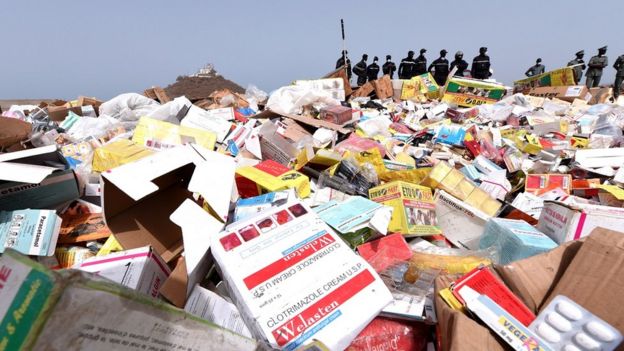
The United States Pharmacopeial Convention (USP), a body
dedicated to setting drug quality standards, set up the Centre for
Pharmaceutical Advancement and Training (CePAT) in Accra, Ghana.
CePAT aims to train African professionals how to screen for
substandard and fake drugs, and since 2013, has helped train 190 professionals
from 32 African countries, says USP chief executive Ronald Piervincenzi.
'People are dying'
But if such tech solutions are working, why are so many people
still dying and suffering as a result of fake medicines?
"Most of the fake drugs are made in Asia and then imported
into Africa," says Mr Simons. "The scale of the trade is huge and
what we're doing is tiny compared to the size of the problem.
"And the very big multinational pharmaceutical companies
have been very conservative - they've taken a long time to get on board,"
he says. "Tech start-ups can't solve the problem by themselves."
Sproxil's Mr Gbamolayun agrees, saying: "We're trying to
raise awareness and spread the good news to brand owners and customers around
the world, but we need to educate a lot more people.
"Counterfeit drugs are still a big problem - people are
dying every day."
Corruption is also to blame, says Mr Simons, with government
ministers often purloining subsidised medicines and selling them privately at
inflated prices, and inspectors accepting bribes to turn a blind eye to fake
shipments.
"There's a black hole of accountability; we need far more
transparency throughout the whole system," he says.
Some involved in the fight against counterfeit drugs have also
complained about the comparatively light sentences for those prosecuted
compared to the sentences given to criminals peddling narcotics.
"In countries with weak drug regulatory bodies that are
poorly funded and poorly staffed, and where enforcement by the customs services
and policy agencies is also weak, counterfeiters will continue to flourish and
operate," warns IFPMA's Mr Ottiglio.
Technology can only do so much
Opinion: It is a good
thing that technology is increasing but as technology increases, there are also
secret crimes that increase since they can do things without getting noticed. People
can fake drugs using technology and through transportation, they were sent to
Africa. I think that sending the fake drugs to Africa doesn’t affect only to
Africa but also to the providers which is, in this case, Asia. Through this
news I think that the reputation of Africa and Asia has decreased and for a
thought I thought of my county making fake drugs and importing them to Africa. It
is possible but what if South Korea didn’t do that or are not doing that? What’s
the faults of those who are not part of it? I think saying Africa, or Asia is
too broad. There could be some countries that don’t make and use fake drugs. It
is just like the Muslim to terrorism problem. Not every Muslim is a terrorist but
they are all affected by the news since they say that it is the Muslims that
caused terrorism. I also think that accepting the fake drugs is the problem. The
Africans might have not known about the drugs but they have to be sure of what
is imported. If they knew the fake drugs, it is not all Africa’s fault. Just as
I said, some countries might not be involved. I also think that cheap things
should be bought cautiously. There are reasons for goods being cheap but not
all of them are reasonable. They could be illegal or secretive so I think being
cautious won’t hurt when buying stuff. I think that the author does a good job
informing people about fake drugs and this would help many Africans and also
Asians to be cautious. Not only the Africans and Asians. It also applies to every
nation.

No comments:
Post a Comment